
The Perfect Co-Op: Game UI/UX and Graphic Design
Imagine this: You’ve just downloaded the most hyped game of the year. The cinematic trailer was breathtaking. You launch the game, and the 3D environments are hyper-realistic—every blade of grass sways perfectly in the digital wind. You are ready to lose yourself for hours.
Then, you open your inventory.
The text is microscopic. The items are scattered without any logical sorting. You try to equip a new sword, but the button mapping is confusing. While you’re fumbling to exit the menu, an enemy attacks, and you die because you couldn't find the health potion in time. Frustrated, you close the game and uninstall it.
The game had a massive budget and brilliant coders, but it failed at the most critical hurdle: the human connection.
Welcome to the gaming industry of 2026. In a $200 billion global market dominated by live-service models and cross-platform play, a studio can no longer rely on graphics alone. Retention is the new currency. If players are confused in the first five minutes, they leave.
Here at Wesually Design Studio, we know that behind every seamless, immersive gaming experience are two unsung heroes working in tandem to keep you in the world: the UI/UX Designer and the Graphic Designer. This is their story.
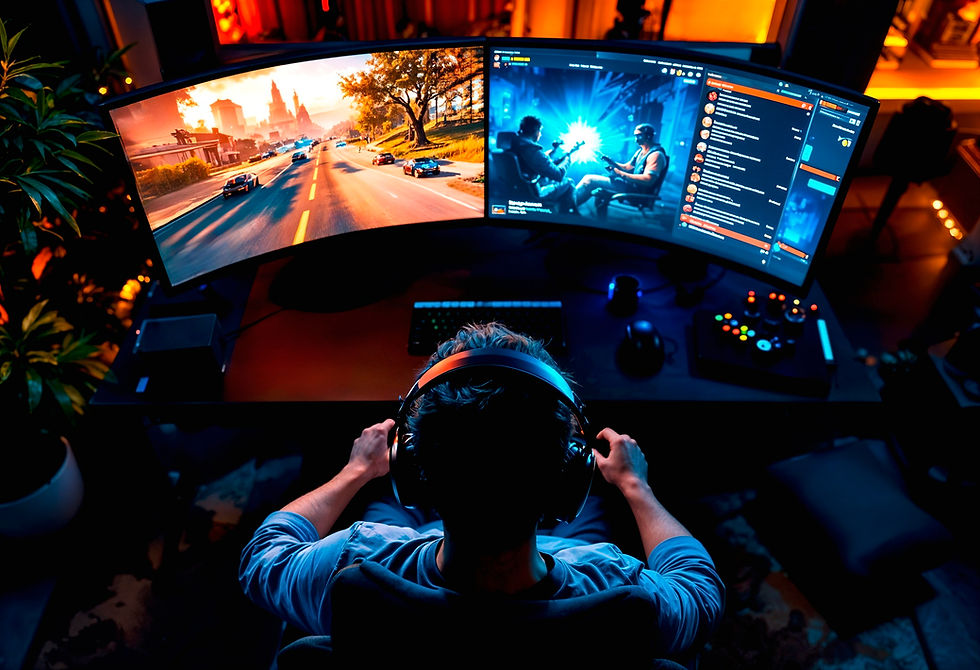
The Invisible Guide: The UI/UX Designer
Think of the UI/UX Designer as the game’s invisible tour guide. Their entire job is to understand the player's psychology and remove friction. They don't just design menus; they design behaviour.
When a player enters a dark, terrifying dungeon, the game designers want them to feel tension. But the UX designer knows that the tension should come from the monsters, not from fighting the camera controls or struggling to read a map.
They are the architects of flow. They map out the player’s journey step-by-step, asking relentless questions:
How many clicks does it take to upgrade a weapon?
If a player switches from a PC mouse to a mobile touch screen, does this layout still make sense?
Is the Heads-Up Display (HUD) giving vital information without blocking the action?
If a UI/UX designer does their job perfectly, the player won't even know they are there. The game will just feel naturally "right."
The World Builder: The Graphic Designer
If the UX designer builds the invisible track, the Graphic Designer (and UI Artist) builds the breathtaking train that runs on it. They are the visual storytellers.
A wireframe is just a blueprint; it has no soul. The graphic designer looks at a gray, blocky layout for a health bar and asks, “Who are we playing as?” If it’s a gritty, futuristic cyberpunk shooter, that health bar becomes a glowing neon tube with digital glitch effects. If it’s a high-fantasy medieval RPG, that same health bar becomes a vial of shimmering crimson liquid, encased in wrought iron and distressed leather.
But their story extends beyond the screen. In a digital storefront where thousands of games are released weekly, it is the graphic designer who creates the bold logo, the striking promotional art, and the iconic branding that makes a player stop scrolling and click "Buy."
The Perfect Co-Op Game UI/UX and Graphic Design
The magic happens when these two disciplines team up to defeat the ultimate boss: Player Churn.
Let’s go back to that frustrating inventory screen from earlier. How would the dynamic duo fix it?
The Strategy: The UX Designer steps in first, tearing down the chaotic layout. They implement a grid system, categorize items by tabs (Weapons, Armour, Potions), and ensure it takes exactly two intuitive clicks to equip an item.
The Art: The Graphic Designer takes that neat, functional grid and breathes life into it. They design custom, hand-painted icons for every potion, select a typography that is highly readable but fits the game's lore, and add subtle animations so the buttons "pop" when hovered over.
The result? The player opens their inventory, easily finds what they need, marvels at the beautiful artwork, and jumps right back into the fight.
At Wesually Design Studio, we believe that structural brilliance and visual execution must go hand in hand. A game with beautiful graphic design but terrible UX is a frustrating museum piece. A game with perfect UX but uninspired graphics is forgettable. But together? They create worlds players never want to leave.


